From NHS Choices YouTube channel: Rosacea is a common but poorly understood long-term skin condition that mainly affects the face. It most commonly affects fair-skinned people from northern Europe and is estimated to affect up to 1 in 10 people. In this video, an expert explains what rosacea is, the symptoms to look out for and the various treatments.
Cathelicidin dysfunction may be a central factor in the pathogenesis of several cutaneous diseases, including rosacea.
Cathelicidins are antimicrobial peptides (AMPs) that protect the skin through 2 pathways:
- antimicrobial activity
- cytokine release, inflammation, angiogenesis, and reepithelialization
23 Eylül 2012 Pazar

Top medicine articles for August 2012
 Here are my suggestions for some of the top articles in medicine for August 2012:
Sanofi Announces FDA Approval for Auvi-Q, First Voice-guided Epinephrine Auto-injector http://goo.gl/4GfPr
Medical Journal of Australia: "Clearly, we overestimate our ability to correctly deploy tests and interpret results" http://goo.gl/q8da8
Drug Resistance Claims Another Gonorrhea Treatment: the oral cephalosporin cefixime http://goo.gl/tR2LW
Social media continues to excel at reaching patients and medical peers http://goo.gl/odKGo
New drugs, procedures, and devices for hypertension : The Lancet http://goo.gl/IbwbL
Data challenge the concept that raising of plasma HDL cholesterol will reduce risk of myocardial infarction http://goo.gl/67eZF
10 Ways to Make EMR Meaningful and Useful http://goo.gl/KimDJ
Tiger snake (Notechis spp) envenoming: Australian Snakebite Project (ASP-13) | Medical Journal of Australia http://goo.gl/YCzRg
Bias in clinical history significantly influenced the accuracy of ECG interpretation http://goo.gl/JjRd6
9 Smartphone Apps to Improve Your Medical Practice http://goo.gl/nUjNP -- 15 Smartphone Apps to Improve Your Practice http://goo.gl/s3dnR
How to Raise Successful (and Happier) Children - NYTimes http://buff.ly/MT4BRr
When metformin alone is insufficient, consider adding a dipeptidyl peptidase-4 inhibitor, linagliptin - Lancet http://goo.gl/bdMkG
Ciprofloxacin for 7 days versus 14 d. in women with acute pyelonephritis: Short courses should be favored - Lancet http://goo.gl/oU3uC
Radiation exposure from CT scans in childhood increases subsequent risk of leukemia and brain tumors - Lancet http://goo.gl/44feV
The articles were selected from my Twitter and Google Reader streams. Please feel free to send suggestions for articles to clinicalcases@gmail.com and you will receive acknowledgement in the next edition of this publication.
Thyrotoxicosis - Lancet 2012 review
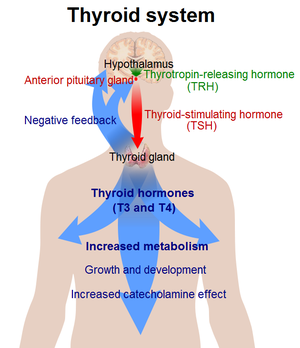 Thyrotoxicosis is a common disorder, especially in women. Thyroid disease affects 7 times more women than men.
Etiology
There are 3 main causes of thyrotoxicosis: Graves' disease, toxic nodular hyperthyroidism, and thyroiditis.
Here are some more details about them:
- Graves' disease (autoimmune hyperthyroidism) is the most frequent cause of thyrotoxicosis
- toxic nodular hyperthyroidism, due to the presence of one or more autonomously functioning thyroid nodules
- thyroiditis caused by inflammation, which results in release of stored hormones
Treatment
The available treatments for thyrotoxicosis have been unchanged for 60 years.
Antithyroid drugs are the usual initial treatment. Thionamides such as carbimazole or its active metabolite methimazole are the drugs of choice.
A prolonged course leads to remission of Graves' hyperthyroidism in only 30% of cases.
Because of this low remission rate in Graves' disease (only 30%) and the inability to cure toxic nodular hyperthyroidism with antithyroid drugs alone, radioiodine is increasingly used as first line therapy. It is the preferred choice for relapsed Graves' hyperthyroidism.
Surgery with total thyroidectomy is an option in selected cases. .
References:
Thyrotoxicosis. The Lancet, Volume 379, Issue 9821, Pages 1155 - 1166, 24 March 2012.
Thyroid disease—more research needed. The Lancet, Volume 379, Issue 9821, Page 1076, 24 March 2012.
Image source: Wikipedia, public domain.
Top medicine articles for September 2012
Here are my suggestions for some of the top articles in medicine for August 2012:More than 30% of hospital patients have test result pending/not reviewed by the time they're discharged http://goo.gl/CCBxr
Corneal snowflakes due to IgG-kappa multiple myeloma - The Lancet images http://goo.gl/FvGBM
Biliary ileus - The Lancet images http://goo.gl/Iv18H
Erectile Dysfunction (ED) as a Reliable Proxy of General Male Health Status regardless of the etiology of ED http://goo.gl/y3kjA
Higher BPA Levels, More Heart Disease? http://goo.gl/10UUi
More Self-Control as a Child, Lower BMI as Adult (study) http://goo.gl/FElcw
FDA approved the first generic version of Actos (Pioglitazone) to treat adults with type 2 diabetes http://goo.gl/kUq9k
Mississippi has the highest proportion of obese adults at 35%, and Colorado has the lowest at 21% (survey) http://goo.gl/JDD6C
"GSK drug halves attacks in hard-to-treat asthma" - anti-IL5 antibody mepolizumab for eosinophilic asthma http://goo.gl/Be6IU
New Epinephrine Auto-Injector Talks Patients Through Injection Process, has a 5-sec countdown, signaling lights http://goo.gl/rYJZI
Autoinflammatory syndromes: Fever is not always a sign of infection - CCJM http://goo.gl/uTc2X
Genetic counselors: Your partners in clinical practice - CCJM http://goo.gl/ZkJb4
Atrial fibrillation: New drugs, devices, and procedures - CCJM http://goo.gl/O0AQN
The demise of the stethoscope as a metaphor of the “hyposkillia” of our times - CCJM http://goo.gl/xu5qS -- An argument for reviving the disappearing skill of cardiac auscultation - CCJM http://goo.gl/59ikK
Dark chocolate can help decrease blood pressure by 2-3 mmHg http://goo.gl/xTnn1
Eating egg yolks as 'bad as smoking' - NHS Choices blog reviews the evidence http://goo.gl/IosBG
30% of new prescriptions never get filled. Will smart pills boost drug compliance? http://goo.gl/omhjJ
Small practices may be least able to take new Medicaid patients - NJ Medicaid physicians get paid 37% of Medicare rates http://goo.gl/g3RLN
4 ways for practices to benefit from a social media presence: Offer information beyond the appointment, Raise physician profiles, Influence online search, Marketing toolkit http://goo.gl/5mAz4
The articles were selected from my Twitter and Google Reader streams. Please feel free to send suggestions for articles to clinicalcases@gmail.com and you will receive acknowledgement in the next edition of this publication.
Chronic insomnia - Lancet 2012 review
 Insomnia is a common condition that can present independently or comorbidly with another medical or psychiatric disorder.
 Treatment of chronic insomnia
Benzodiazepine-receptor agonists (BzRAs) and cognitive-behavioural therapy (CBT) are supported by the best empirical evidence.
Benzodiazepine-receptor agonists (BzRAs) are effective in the short-term management of insomnia, but evidence of long-term efficacy is scarce. Also, most hypnotic drugs are associated with potential adverse effects.
Cognitive-behavioural therapy (CBT) is an effective alternative for chronic insomnia.
CBT is more time consuming than drug management but it produces sleep improvements that are sustained over time.
However, CBT is not readily available in most clinical settings. Access and delivery can be made easier through:
- telephone consultations
- group therapy
- self-help approaches
How to succeed? Get more sleep
In this 4-minute talk, Arianna Huffington (founder of The Huffington Post) shares a small idea that can awaken much bigger ones: the power of a good night's sleep. Instead of bragging about our sleep deficits, she urges us to sleep our way to increased productivity and happiness -- and smarter decision-making.
References:
Chronic insomnia. The Lancet, Volume 379, Issue 9821, Pages 1129 - 1141, 24 March 2012.
Image source: A halo around the Moon. Wikipedia, GNU Free Documentation License.
Geneticists verify cholesterol-cancer link
University of Rochester Medical Center scientists discovered new genetic evidence linking cholesterol and cancer, raising the possibility that cholesterol medications could be useful in the future for cancer prevention or to augment existing cancer treatment.
The data, published in the online journal Cell Reports, support several recent population-based studies that suggest individuals who take cholesterol-lowering drugs may have a reduced risk of cancer, and, conversely that individuals with the highest levels of cholesterol seem to have an elevated risk of cancer.
The cancer-cholesterol question has been debated since the early 20th century, and along with it doctors and scientists have observed various trends and associations. However, until now genetic evidence directly linking cholesterol and malignancy has been lacking, said senior author Hartmut (Hucky) Land, Ph.D., Robert and Dorothy Markin Professor and chair, Department of Biomedical Genetics, and director of research and co-director of the James P. Wilmot Cancer Center at URMC.
"Scientifically it is very satisfying to have data that support longstanding ideas about cholesterol in the context of cancer," Land said. "Our paper provides a rationale for cholesterol targeting as a potentially fruitful approach to cancer intervention or prevention strategies."
Cholesterol is a fat-like substance supplied in foods and made in cells throughout the body. Too much cholesterol is bad for the heart and vascular system. It is typically measured as serum cholesterol by routine blood tests.
Unlike serum cholesterol that is bound to proteins, however, cholesterol also hides inside cells. While locked inside cell membranes before it is eventually exported, cholesterol has an impact on cell growth and survival. A gene, known as ABCA1, is at the crossroads of the process that shuttles intracellular cholesterol outbound.
Several years ago while conducting unrelated experiments that were published in the journal Nature, Land and colleagues first noticed the importance of ABCA1. At that time, they identified a network of approximately 100 so-called "cooperation response genes" that mediate the action of cancer genes. ABCA1 was found among these genes and is frequently turned off in presence of other mutant cancer genes.
In the latest investigation, Land and co-author Bradley Smith, Ph.D., a post-doctoral fellow in the Land lab, wanted to further understand the role of ABCA1 and cholesterol in cancer. They found that defective cholesterol exportation appears to be a key component in a variety of cancers.
The proper function of ABCA1, in fact, is critical for sensing of cell stress. If ABCA1 function is lost in cancer cells, cholesterol is allowed to build up in the cells' mitochondria, or energy centers, making their membranes more rigid. This in turn inhibits the function of cell-death triggers that normally become activated in response to cell stresses, as for example cancer gene activation. Therefore, when functioning properly ABCA1 has anti-cancer activity – in the sense that by keeping mitochondrial cholesterol low it protects the functioning of cellular stress response systems and acts as a barrier to tumor formation and progression.
Smith and Land also demonstrated that some of the relatively rare ABCA1 mutations found in human colon cancers by other investigators disabled the gene's ability to export cholesterol. And by re-establishing the cholesterol export function in human colon cancer cells, they inhibited the cells' ability to grow as cancers when grafted onto mice.
The URMC study, therefore, is the first to directly show how ABCA1 loss-of-function and cholesterol may play a role in cancer.
Millions of Americans take cholesterol-lowering drugs or statins, as prescribed by physicians. The drugs work by blocking the action of key enzymes in the liver, which synthesizes cholesterol. Clinical trials also are evaluating statins as a tool against cancer, and some previous studies suggest that when used in combination with chemotherapy, statins might make chemotherapy more effective by sensitizing certain cancer cells to chemotherapy-induced cell death.
Land, however, urges caution and further study. Doctors do not know the appropriate statin dose for cancer prevention or treatment of cancer-related conditions. Side effects cannot be ignored either, and little research has distinguished between the responses among people who take statins.
"The link between cholesterol and cancer is clear," Land said, "but it's premature to say that statins are the answer."
Scientists conclude high fructose corn syrup should not be blamed for obesity
A new article published today in International Journal of Obesity found there is no evidence to suggest the current obesity epidemic in the United States can be specifically blamed on consumption of high fructose corn syrup (HFCS).
The commentary concludes that after an extensive review of all available HFCS research, there is overwhelming evidence showing HFCS is nutritionally equivalent to sugar. This opinion is in-line with the American Medical Association and the Academy of Nutrition and Dietetics, both of which concluded that HFCS is not a unique cause of obesity.
The authors state that while there has been a large amount of debate in the media about the impact of HFCS on obesity levels, the fact is "Sucrose (sugar) and HFCS are very similar in composition….and are absorbed identically in the human GI tract."
"The public discussion about HFCS will likely continue to rage on and more studies will be conducted," said James M. Rippe, M.D., Founder and Director of the Rippe Lifestyle Institute, and Professor of Biomedical Sciences at the University of Central Florida, one of the article's authors. "However, at this point there is simply no evidence to suggest that the use of HFCS alone is directly responsible for increased obesity rates or other health concerns."
The article goes on to discuss a number of research trials that have been conducted on the issue of HFCS and obesity, and concludes that at this time the evidence shows no short-term health differences between the use of HFCS or sugar could be detected in humans. Weight gain, glucose levels, insulin and appetite were not adversely affected by the use HFCS over sugar.
The commentary was co-authored with Dr. Rippe by David M. Klurfeld, Ph.D. of the USDA Agricultural Research Service, John Foreyt, Ph.D. of Baylor College of Medicine, and Theodore J. Angelopoulos, Ph.D., MPH Professor and Director, Laboratory of Applied Physiology Department of Health Professions at University of Central Florida.
HFCS was developed in the mid-1960's as a more flexible alternative to sugar and was widely embraced by the food industry. The use of HFCS grew rapidly from 1970-1999 where usage peaked. Since 1999, the use of HFCS has declined while obesity rates have continued to rise. Sucrose is still the dominant sweetener worldwide with over nine times the consumption of HFCS.
Kaydol:
Kayıtlar (Atom)